¶ Tuning
NOTE! Not all tuning adjustments are available for all transmission/ECU/car integrations. If the adjustment parameter is hidden, it is not relevant for your used ECU/transmission setup.
¶ Torque Calculation
On ECUs that don't natively send out torque estimation values, CANTCU takes over the job of doing torque calculations internally. The based on various runtime values sent from the ECU, usually MAP/VE(or some sort of load)/losses. A “Torque Factor” input is required. This number does not represent a direct torque value in itself, but is being calculated from user inputs (Calculate-button). To calculate the correct factor, the following three values (Torque, MAP, VE) should be known on a specific operating point of the engine. Easiest and most accurate calculations are achieved when using maximum values.
Example calculation of an engine that outputs 930Nm at 2.2bar boost and 106% VE, resulting in a Torque Factor of 293.
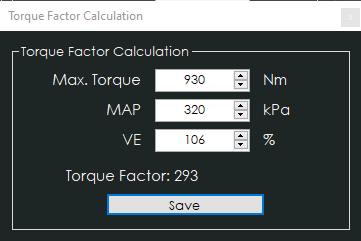
- (Estimated) engine torque (e.g. 930Nm)
- MAP (Manifold Absolute Pressure) in kPa. If using PSI, convert by formula MAP=((Boost PSI / 14.7) + 1) * 100. Remember to account for Absolute pressure (+100kPa) if you are looking at Boost PSI pressure. (e.g. 2.2bar (32.34PSI) boost = 220kPa boost = 320kPa absolute)
- VE. Unless separately mentioned, the VE value is directly fetched from the ECU fuel map. Note that you should input the VE value from the specific engine operating point (e.g. VE 106% at 4200RPM & 320kPa = 930Nm), not from maximum values.
General notes:
- Too high torque factor will cause unrealistic too high torque indication, resulting in unnecessary rough shifts
- Too low torque factor will cause too low torque indication, resulting in slippage and, at worst, transmission damage
¶ Torque Correction
Used on ECUs that natively send out torque estimation values. This is a percentual factor being applied to the torque estimation coming from the ECU. On stock ECUs running stock tunes the estimation should always be perfectly accurate, not needing any adjustment of this function. However, on tuned ECUs the torque estimation sometimes isn't accurately represented. This might be caused by a poor/cheated tune, or simply by the fact that the ECU cannot output a higher torque value than standard.
Torque Out = ECU Torque In * ((Torque Correction Factor / 100) + 1)
e.g. ECU shows an indication of 500Nm when real torque is 800Nm → a +60% torque correction is necessary → 500 * ((60 / 100) + 1) = 800Nm.
¶ Launch Control
Adjustment function available on DCTs. Torque value being sent to the transmission when launching. Default value -1000Nm which releases the clutches. Do not touch unless you are experience issues with too much dragging of the clutches while launching.
¶ RPM Settings
- Idle RPM - Your engine idle RPM. This value is sent to the transmission, helping it know when to release clutches etc.
- Max RPM - Your engine maximum RPM (= rev limiter). This value is sent to the transmission, preventing situations where the engine would overrev due to other limits (max rpm in transmission software etc) being wrongly input. Note that you need to set this value at minimum to the real engine revlimit, as you will get fault codes and limp modes from the transmission whenever this value is exceeded.
¶ Blip Settings
Fine tuning/limiting of request being sent to the ECU.
- Initial Blip Delay - Recommended blip delay is 0-20ms, use higher values if clutches aren't releasing quickly enough before blip is initiated. DCT-specific(?), we haven't noticed any significant improvement/change on 8HPs.
- Max Blip Time - Maximum Blip Time ensures deactivation of the blip in error situations. Note that your ECU should also have a safety timeout feature for max blipping time in case of lost CAN-communication etc.
¶ Takeoff Torque
Note that this function mainly effects DCT transmissions as it's based on engaging clutches vs 8HP takeoff which is based on torque converter physics.
Adjusts the amount of torque being sent to the transmission from pedal position. This has an influence on how hard/fast the clutches grab. Adjust to a lower value if takeup is harsh, and to a higher value if takeup slips the clutches a lot causing excessive high RPM.
¶ Reported Pedal Correction
Adjusts the throttle pedal value sent to transmission. This has an effect on shiftpoints in automatic (D/S) modes.
- Negative correction -> Lower shiftpoints
- Positive correction -> Higher shiftpoints
NOTE! Please use the shiftmap editor in CANTCU Flasher (if transmission supported) as a primary way for adjusting shift RPM.
Simulate Kickdown - When enabled, kickdown signal is triggered when the REAL pedal position is >99.5%. Useful for cars with no kickdown switch in the pedal, and kickdown functionality is desired.
¶ Braking Correction
Adjusts the reported braking force value sent to transmission. This has an effect on downshift shiftpoints (while braking) in auto-modes.
- Negative correction -> Lower shiftpoints
- Positive correction -> Higher shiftpoints
¶ Blip Control
Only used on ECUMaster Black.
- Maximum Blip Throttle - maximum DBW throttle angle during blips
- Decel/Driving Blips - changes aggressiveness/gain of blip activation
¶ Drag Upshifts
Experimental feature that might not work correctly, and might be discontinued in future releases
Automatic Upshift in M-Mode, activated by DIN "Drag Upshift". Additionally, if wheelspeed difference between axles are > 20%, upshift will not trigger.